Solar eclipse 2026: UK times, visibility and safe viewing on 12 August
The 12 August eclipse is partial from the UK, not total. Here are the London timings, why the south-west sees more coverage and how to view it safely.
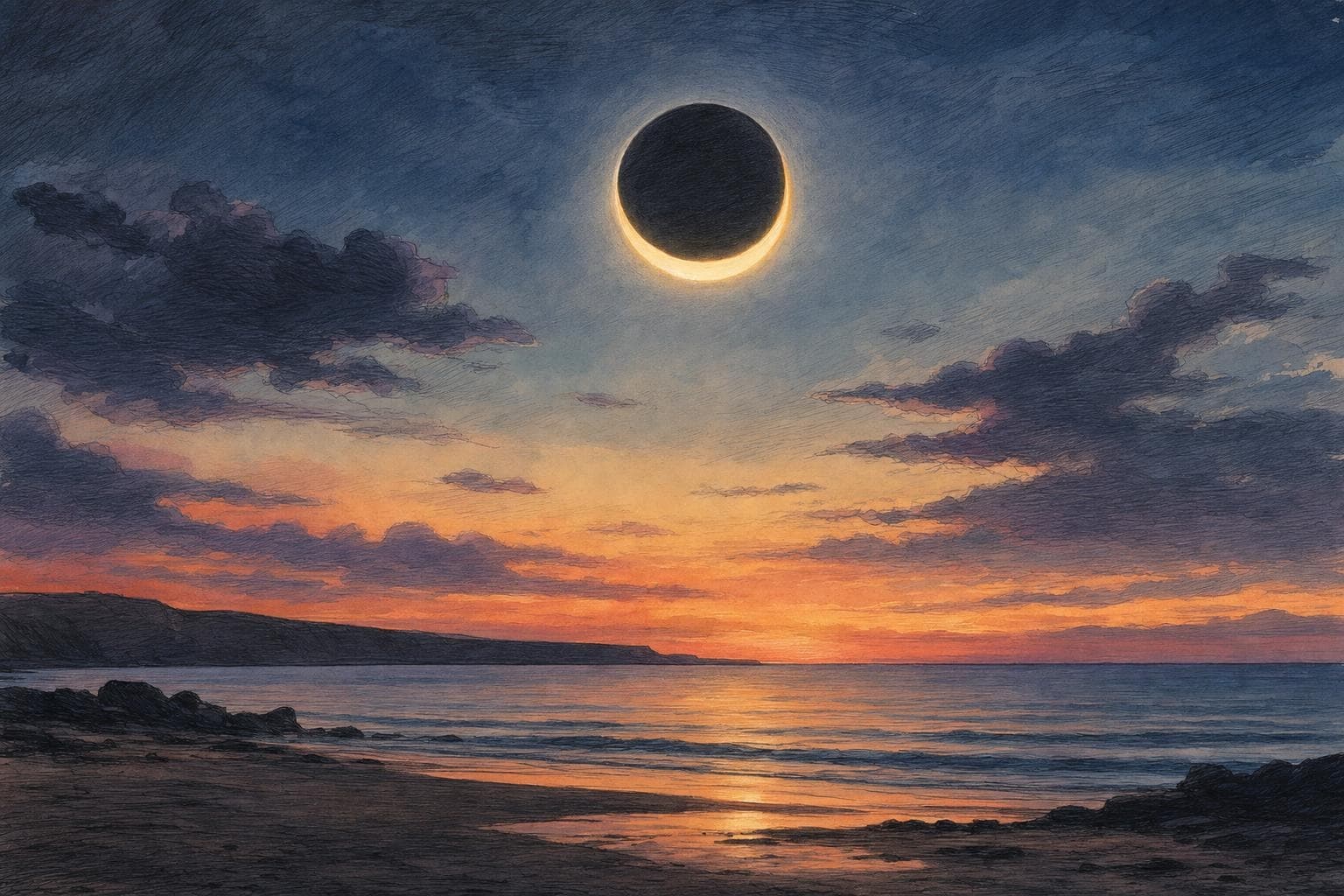
This is a GPT Image 2 generated editorial illustration, not a photograph of the event.
The solar eclipse on Wednesday 12 August 2026 will be partial across the UK. In London, first contact is expected at 6.17pm BST, the maximum at 7.12pm and the partial phase ends at 8.06pm; times vary by place. The event is total only along a narrow path elsewhere, including parts of Spain, Iceland and Greenland. Do not look at the Sun with ordinary sunglasses: certified solar viewers or an indirect projection method are required throughout the UK’s partial eclipse.
What people in the UK will actually see
The UK is outside the path of totality. That distinction matters: a partial eclipse means a crescent of the Sun remains visible, so daylight does not switch off and the eye-safety rule never relaxes. Royal Observatory Greenwich says the Moon will cover roughly 90% of the Sun from London at maximum, with coverage generally increasing towards the south-west. Cornwall is expected to see about 95%, while the proportions and timings change across the country.
The total phase belongs to a much narrower corridor across parts of Greenland, Iceland and northern Spain. Calling the UK event ‘a total eclipse’ would therefore be inaccurate even though the partial phase will be unusually deep. Google Trends showed active UK interest in “solar eclipse 2026” at the time this guide was verified, which is understandable: it is the largest coverage from the UK and Ireland since 1999, but it remains a partial view from Britain.
- The UK sees a partial eclipse, not totality.
- The south-west generally has the greatest UK coverage.
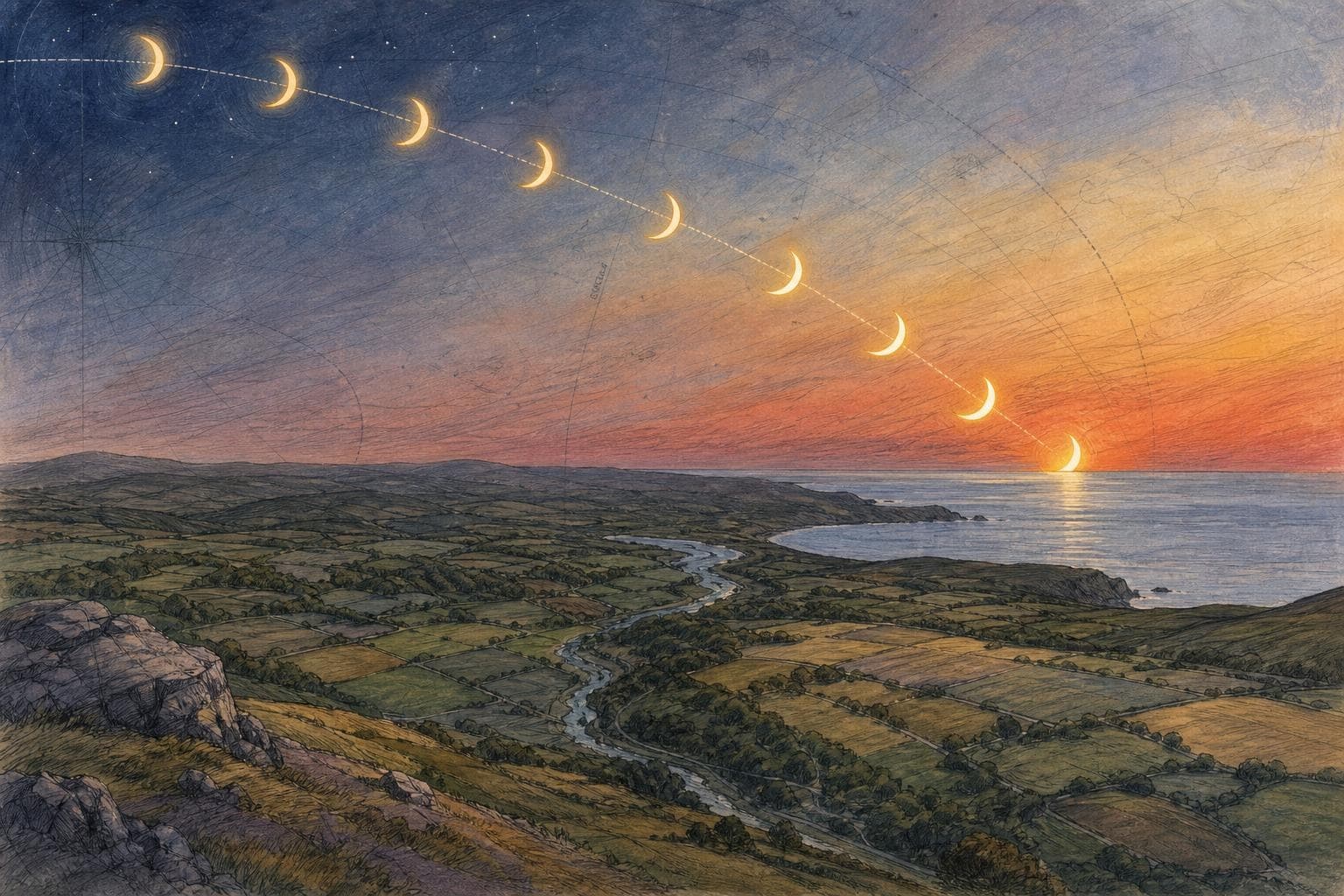
This is a GPT Image 2 generated editorial illustration, not a weather map or event photograph.
London timings and why local planning matters
For London, Royal Observatory Greenwich lists first contact at 6.17pm BST, maximum at 7.12pm and the end at 8.06pm on 12 August. NASA’s London catalogue independently gives 17:17, 18:13 and 19:06 in standard time and notes that daylight saving adds an hour. The one-minute difference at maximum reflects how event tables are rounded; it is not a disagreement about the event. For any other town, use a location-specific official or established astronomical listing rather than copying London times.
The Sun will be low in the west-north-west as the eclipse progresses. A clear western horizon matters more than simply travelling a long distance within the UK. Cloud cover, local buildings and trees can block the view even when the astronomical timing is correct. Treat a forecast as a forecast, not a promise: the practical plan is a safe viewing method plus a location with an unobstructed western sky and a backup way to follow an official livestream.
- London: 6.17pm, 7.12pm, 8.06pm BST.
- Use local timings and a clear western horizon for any other location.
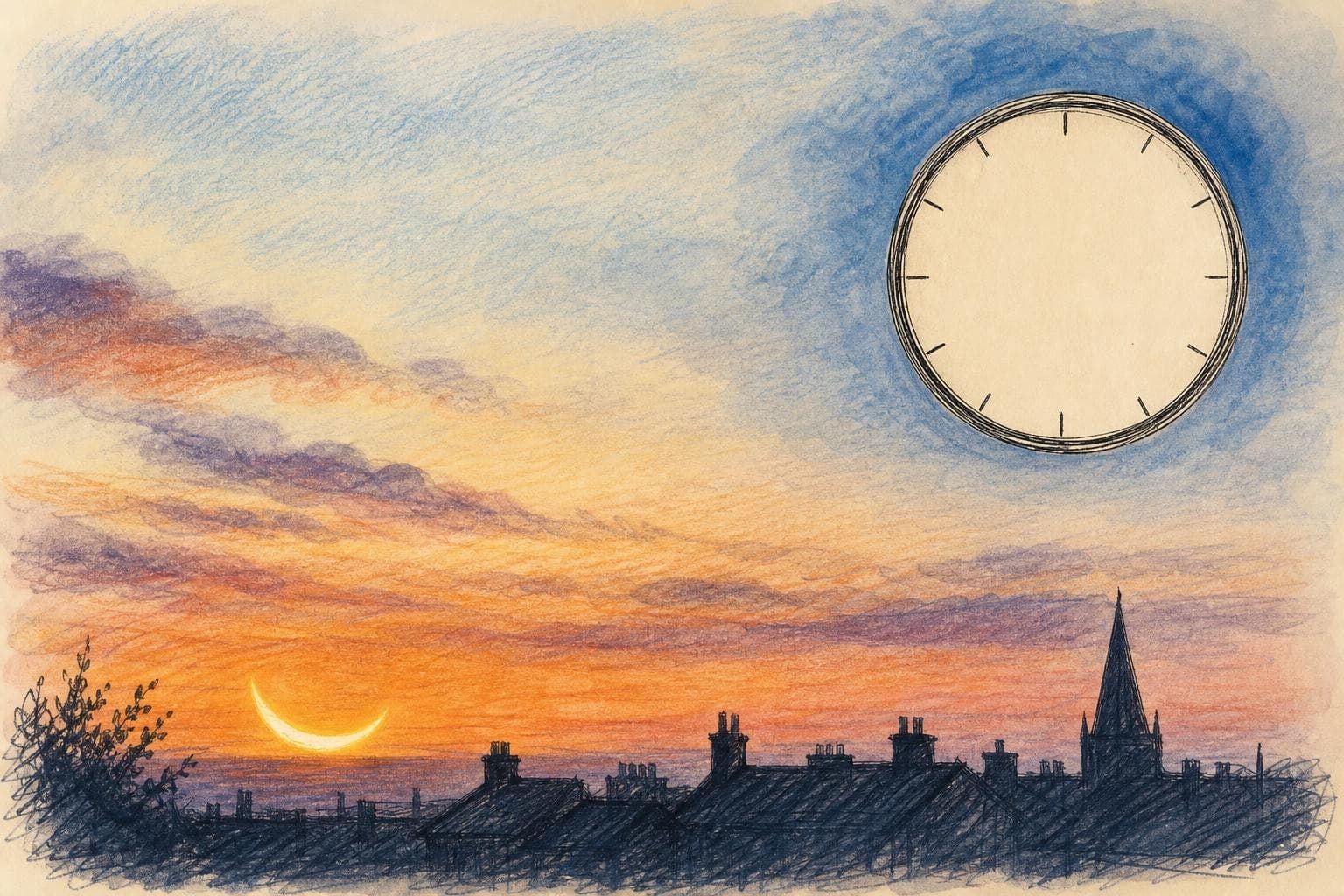
This is a GPT Image 2 generated editorial illustration, not a live sky image or precise location chart.
Safe viewing: the rule does not change during a partial eclipse
UK Health Security Agency warns that ordinary sunglasses do not protect the eyes for eclipse viewing. Dark lenses can make the Sun feel less uncomfortable while allowing harmful radiation to reach the retina. The agency advises using genuine eclipse glasses or a handheld solar viewer with filters meeting ISO 12312-2:2015(E), and not using a viewer that is scratched, torn or otherwise damaged.
Indirect viewing is a useful alternative when done carefully. A pinhole projector can cast the Sun’s image onto paper; the shadow from a colander or gaps between leaves can produce multiple projected crescents. The key is to watch the projection, not the Sun. A normal telescope or binoculars must never be pointed at the Sun unless it has an appropriate solar filter fitted for that instrument. This is safety guidance, not a substitute for medical care; seek urgent professional advice if you believe you have injured your eyes.
- Ordinary sunglasses are not safe eclipse equipment.
- Look at a projection, never at the Sun, when using an indirect method.
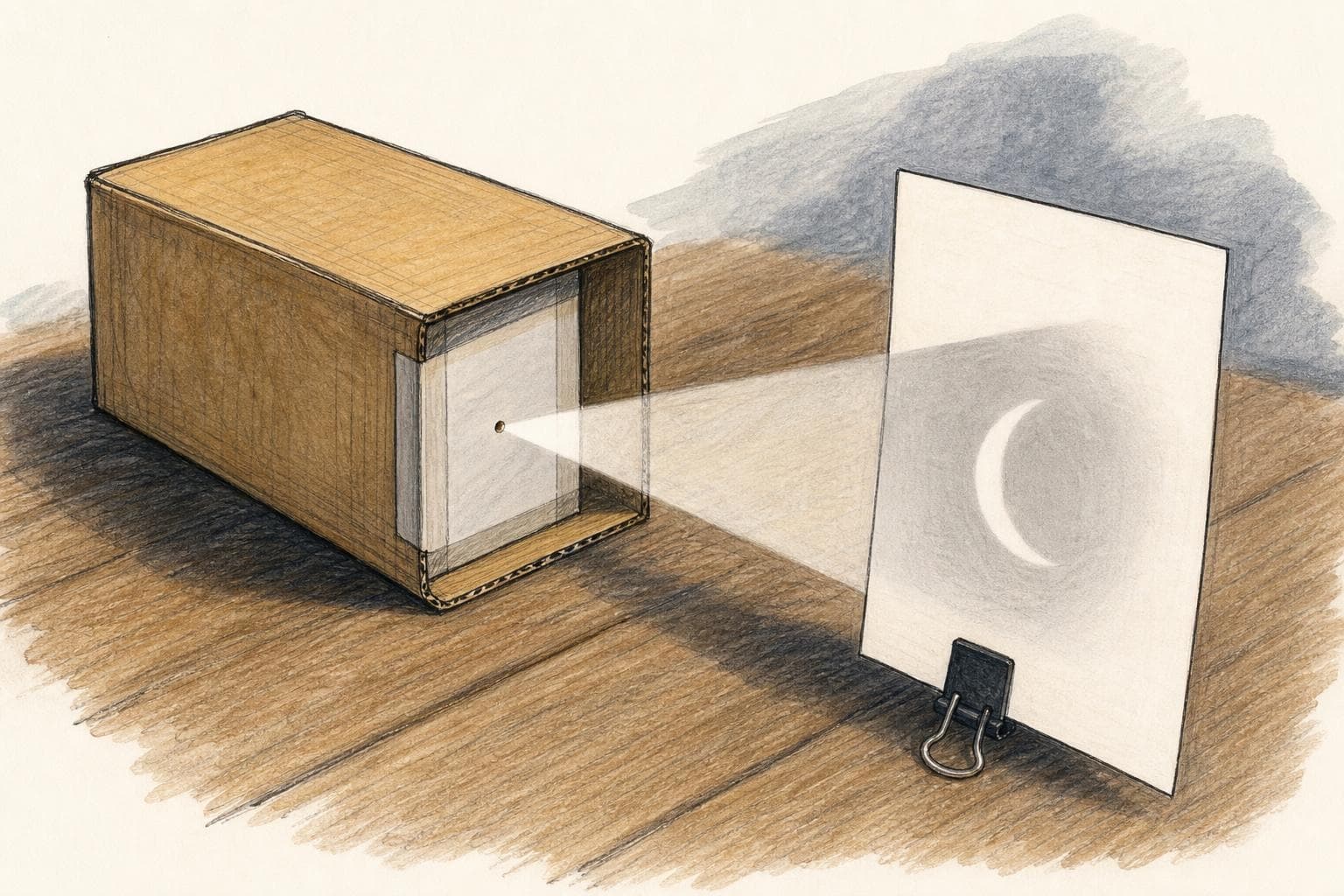
This is a GPT Image 2 generated editorial illustration, not a medical or safety certification image.
Do not confuse travel plans with UK visibility
A deep partial eclipse can be memorable, but it is not a shorter form of totality. In totality, the Moon covers the whole solar disc for an observer inside the narrow central path; outside that path, even a thin remaining crescent is intensely bright. The 2026 total path does not cross the UK. Anyone considering travel should independently verify the location, timing, road conditions, local weather and the rules of the host area rather than relying on a generic eclipse post.
The event also occurs near sunset for UK viewers. That makes the viewing window more sensitive to terrain and the horizon than a midday eclipse would be. A hill, building or cloud bank in the wrong direction can remove the view before the calculated end time. Public observatories and local astronomy groups may provide supervised options, but availability and entry arrangements should be checked directly with each organiser.
- A UK partial eclipse is not a total eclipse experience.
- Travel and event details need separate, location-specific confirmation.
What to check again before 12 August
The astronomical date and geometry are stable, but the useful day-of information is not. Recheck a local forecast, any official weather warning, travel arrangements and the condition of your viewer shortly before leaving. If your solar viewer is not genuinely certified or is damaged, choose an indirect method or an official livestream instead. Do not improvise with sunglasses, exposed film, smoked glass or unfiltered optics.
This guide will be reviewed if an official UK safety authority changes its advice or if a material change affects public viewing arrangements. Its next planned verification point is 11 August 2026, with a shorter update window for any official weather or safety notice. The primary question is simple: the UK will see a partial eclipse on 12 August; plan for the local time and observe only with a safe method.
- Recheck the forecast and equipment shortly before the event.
- Next planned verification: 11 August 2026 or earlier if official advice changes.
Source ledger
5 sources checked
- 01Royal Observatory Greenwich12 August 2026 partial solar eclipseAccessed August 3, 2026
- 02UK Health Security AgencyHow to watch the solar eclipse safely this summerJuly 23, 2026
- 03NASA Goddard Space Flight CenterMajor Solar Eclipses Visible from London, EnglandAccessed August 3, 2026
- 04Associated PressAugust’s total solar eclipse will sweep over Spain, Iceland and GreenlandAugust 2, 2026
- 05Google TrendsTrending now in the United KingdomAccessed August 3, 2026
No third-party news image or video was copied for this article.